
How AI Is Changing Retail Pricing: A C-Level Guide for 2026
For most of the last decade, retail pricing looked the same at every major chain: a small team, a big spreadsheet, a competitor-match rule, and a quarterly review. It was imperfect, but it was manageable.
It isn't manageable anymore. Assortments have exploded, promotional calendars have compressed, marketplaces publish competitor prices by the minute, and shoppers compare offers on the phone in their hand. Pricing is now a real-time discipline attached to a fundamentally non-real-time organization.
This is where AI — and more specifically, AI agents — start to matter at the executive level. Not as a science project, and not as a swap-in for a legacy rules engine, but as a structural change in how pricing decisions get made, by whom, and at what cadence.
This article is for CEOs, COOs, and Chief Commercial Officers trying to answer a question their boards are already asking: how is AI changing retail pricing, and what does my operating model need to look like in the next 12–18 months?
Why 2026 Is the Inflection Point for AI-Driven Pricing
Three things shifted in parallel that make this year different from the last five.
First, the models got good enough. Large language models and modern forecasting systems can now reason over messy retail data — SKU hierarchies, incomplete cost files, free-text supplier notes — without six months of data engineering upfront.
Second, the integrations got cheap. Connecting an AI pricing layer to an ERP, a POS, and a price scraping feed is now a days-long project, not a nine-month implementation.
Third, the competitive pressure got uncomfortable. Early adopters are reporting concrete margin improvements and double-digit percentage reductions in repricing cycle time. That's no longer a nice-to-have differentiator; it's a margin gap your peers can widen every quarter they run faster than you.
The net effect: AI pricing has moved from the innovation slide to the operating-plan slide.
From Rules to Reasoning: What AI Agents Actually Do in Pricing
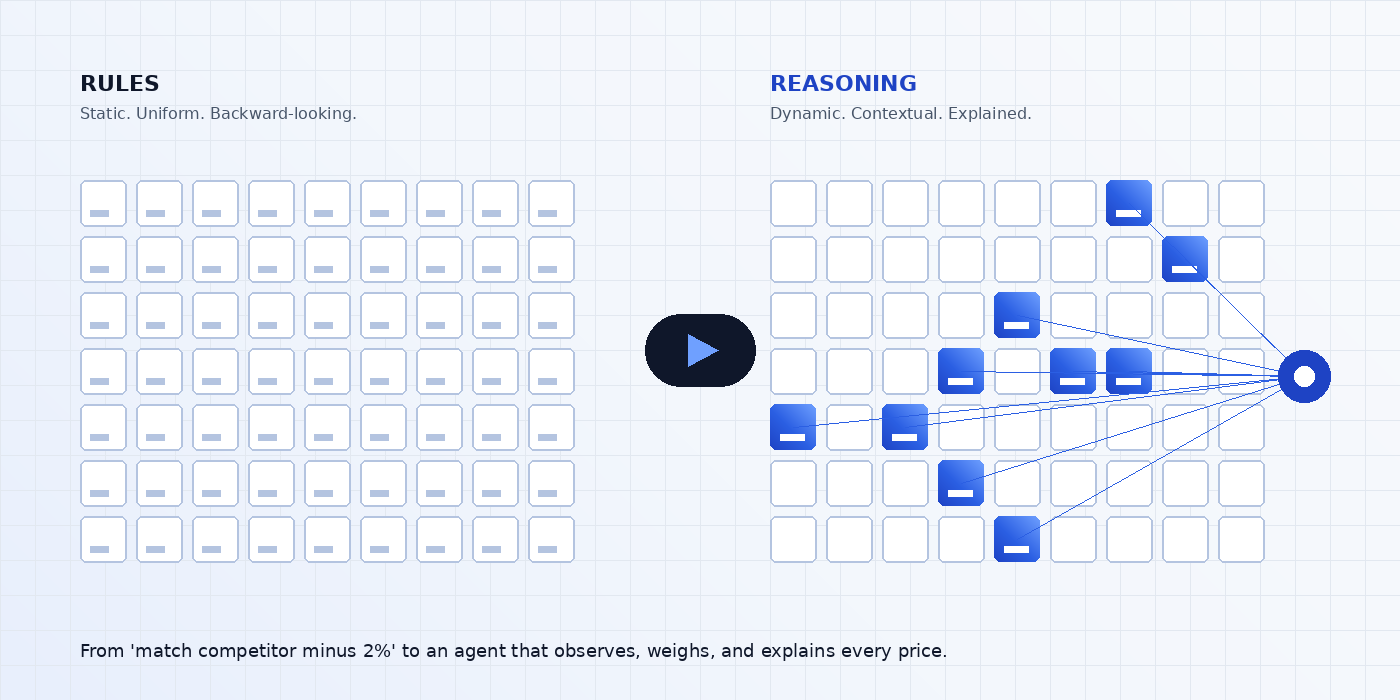
The phrase AI pricing gets used loosely, so it's worth being precise. Most retailers today run some form of rule-based engine: match the lowest competitor minus 2%, keep a 32% markup, don't go below cost. That's automation, not intelligence.
An AI agent is different in three ways.
It observes a much wider field — sales velocity, elasticity by segment, competitor moves, stock cover, promotional overlap, weather, local events — and keeps that picture current.
It reasons about trade-offs. Instead of following a single rule, it weighs margin against volume against competitive position against inventory risk, and picks a price that balances them.
It explains itself. The better systems don't just output a new price; they output a short justification a category manager can read, challenge, or override in seconds.
That combination — observe, reason, explain — is what separates an agent from a script. And it's why the conversation at the executive level has shifted from which pricing tool do we buy? to what parts of the pricing job do we delegate to agents, and what parts do we keep human?
Four Ways AI Is Reshaping Retail Pricing Today
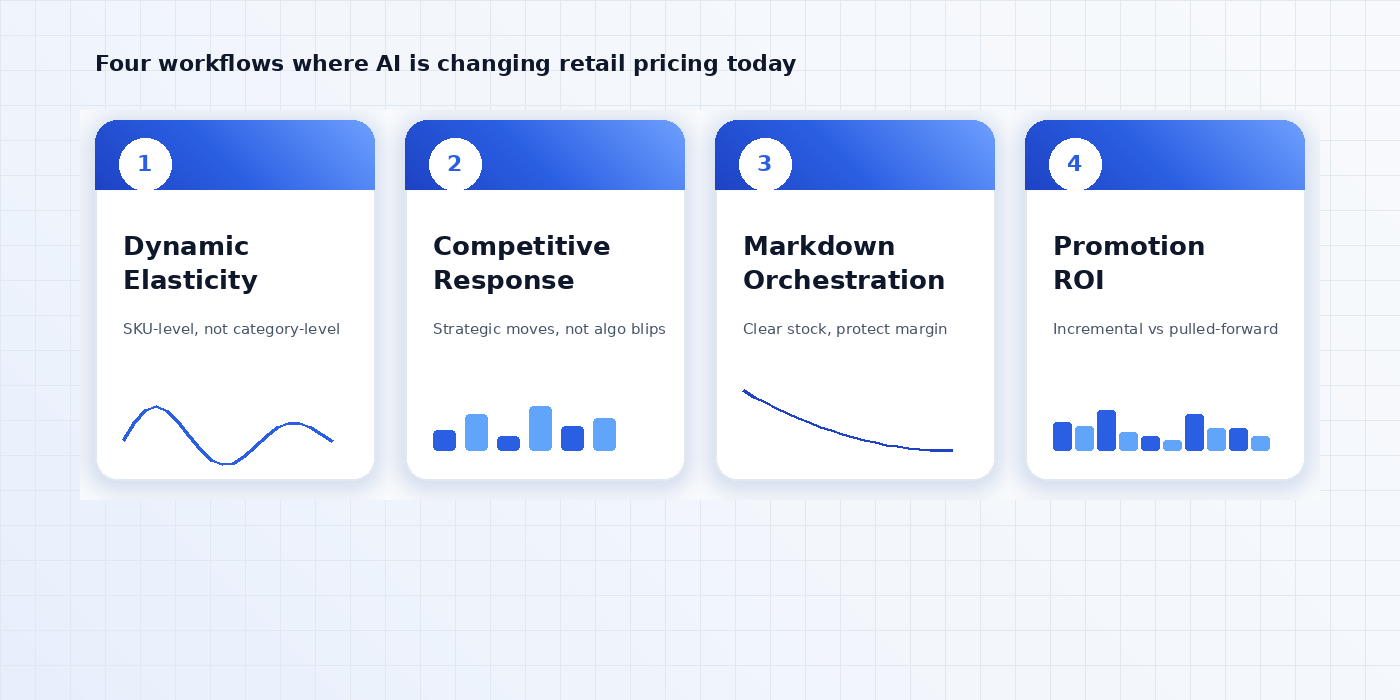
At a practical level, AI is changing retail pricing across four workflows that together represent the bulk of a pricing team's time and a disproportionate share of P&L impact.
Dynamic elasticity modeling
Traditional pricing assumes a single elasticity per category. AI pricing systems model elasticity at the SKU level, and crucially, how it shifts — by channel, by day of week, by competitive context. That lets retailers lift prices where customers don't notice and hold them where they do.
Competitive response
Scraping competitor prices is old news. What's new is AI that distinguishes a strategic competitor move from an algorithmic blip, and only reacts when it should. This alone eliminates a huge category of self-inflicted margin damage: the race-to-the-bottom triggered by a competitor's software bug.
Markdown orchestration
End-of-season markdowns are one of the most expensive decisions a retailer makes. AI agents simulate multiple markdown curves against stock position, sell-through targets, and category adjacencies — and recommend the plan that clears inventory with the least margin give-up.
Promotion ROI
Most promotional calendars are built on habit. AI pricing flags which promotions actually drove incremental demand versus which ones just pulled forward sales the retailer was going to make anyway. Over a year, that's typically the single largest margin recovery opportunity in the pricing portfolio.
The C-Level Economics: Where Margin Actually Shows Up
If you're sitting in the CFO's chair or presenting to the board, the right framing isn't AI will optimize our prices. It's: here is where the margin and productivity show up.
Mid-market retailers piloting AI-driven pricing generally see impact in four places.
Gross margin lift of roughly 1–3 percentage points in categories with meaningful elasticity variance, realized within two to three quarters of rollout. The mechanism is boring but durable: thousands of small, defensible price moves that a human team couldn't execute at that cadence.
Repricing cycle time falling from weeks to hours — in Nordic retail we've seen cuts of up to 80%. That's not just an efficiency metric; it's a strategic one. When you can reprice a category in an afternoon, you can respond to a competitor launch the same day.
Fewer unintended markdowns. Because the system is continuously pricing against inventory position, fewer SKUs arrive at end-of-season mispriced. For apparel and electronics, this is often where the headline ROI lives.
Pricing team leverage. Your best pricing analysts stop maintaining spreadsheets and start working on strategy, exception handling, and cross-functional decisions. The headcount conversation is almost never about reduction — it's about redirecting scarce expertise to higher-leverage work.
The Operating Model Shift: Humans + Agents, Not Humans Replaced
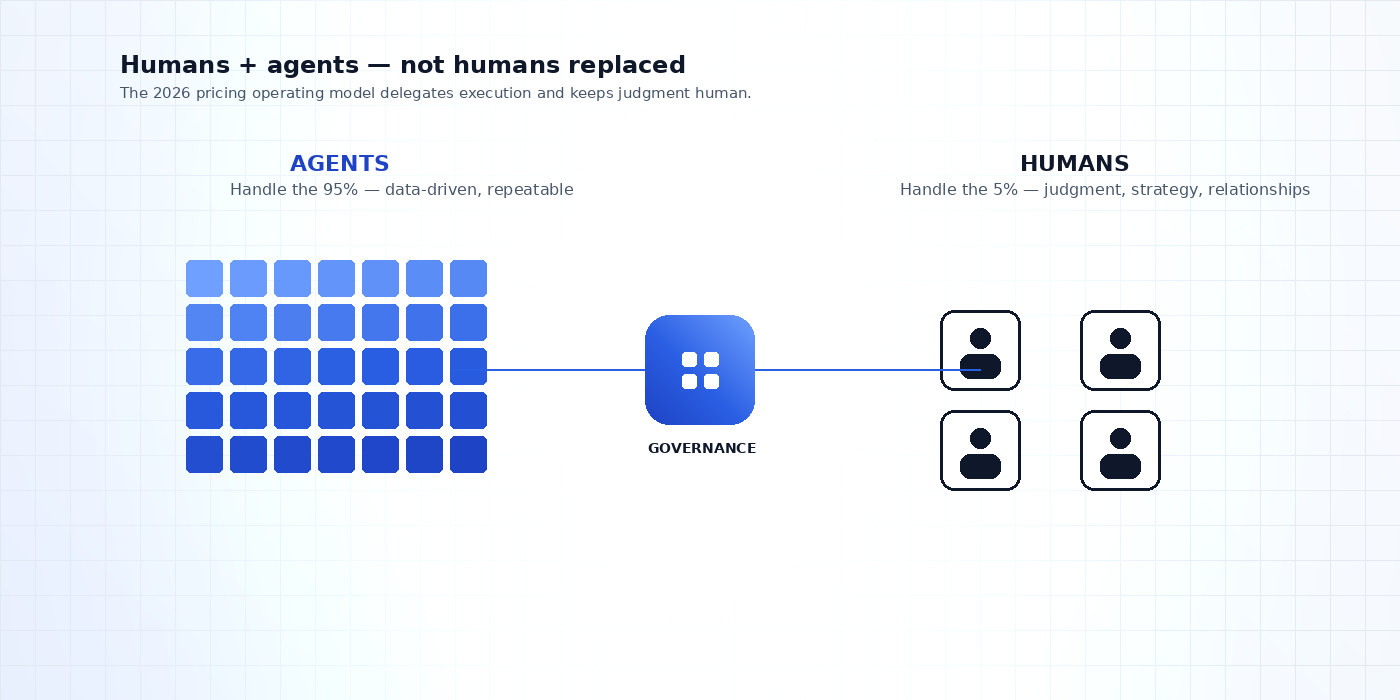
The single most common executive misread of AI pricing is framing it as automation. It isn't — it's delegation.
The high-performing operating model looks like this: agents handle the 95% of pricing decisions that are well-defined and data-driven. Humans handle the 5% that involve judgment — vendor relationships, brand positioning, strategic bets, and the genuinely ambiguous calls. And humans review a sample of agent decisions weekly, the way a senior partner reviews a junior's work.
That split changes what you hire for. The pricing team of 2026 looks less like a group of Excel power users and more like a small cell of category strategists plus a pricing-ops function that manages the agents themselves — their inputs, guardrails, and performance.
Governance changes too. Executives should expect monthly reporting on agent decisions: how many price changes, what percentage were overridden by humans, what margin and volume outcomes followed. Without that feedback loop, agents drift and trust erodes. With it, the system compounds.
How to Pilot AI Pricing Without Betting the Store
Based on what's worked and what hasn't at mid-market retailers, a defensible pilot has five elements.
Pick the right categories. Start with one or two where elasticity varies meaningfully across SKUs — typically electronics, home goods, or health and beauty. Avoid commodity categories where there's nothing for the model to learn, and avoid hero SKUs where a mispricing is a PR problem.
Set tight guardrails up front — a maximum price change per cycle, cost-plus floors, competitor-match ceilings. Agents perform better when their decision space is explicitly bounded.
Require explanations for every recommendation. If the system can't tell a category manager why it's suggesting a price, it's not ready.
Run in shadow mode for two to four weeks. Let the agent recommend; keep humans deciding. Compare outcomes. This builds trust and surfaces data-quality issues before anything hits the shelf.
Agree on success metrics before the pilot starts — margin lift, cycle time, override rate — and review them monthly. Ambiguous success criteria are how pilots die.
The Executive Agenda: Three Questions to Ask This Quarter
If you do nothing else after reading this, bring these three questions to your next commercial review.
Where does our pricing decision currently lag the market, and what's that lag costing us in margin? Put a number on it. It's almost always bigger than the team thinks.
What would change in our team, systems, and governance if 90% of price moves were made by an agent and reviewed by a human? This is the operating-model question, and it's the one most retailers haven't seriously worked through.
Which peer is 12 months ahead of us on this, and what will that gap look like at 24 months? Compounding advantages in pricing are quiet until they aren't.
Frequently Asked Questions
Is AI pricing the same as dynamic pricing?
No. Dynamic pricing is a pattern — prices change frequently based on conditions. AI pricing is a technology that decides what those prices should be. You can do dynamic pricing with a rules engine, and plenty of retailers do. What AI adds is the ability to reason across more variables and explain the decision.
Will AI agents replace our pricing team?
In practice, no. They redirect the team's attention. The categories, relationships, and strategic calls that matter most still need human judgment. What changes is the proportion of time spent on execution versus strategy.
How long does an AI pricing rollout take?
A shadow-mode pilot in one or two categories typically runs six to eight weeks. Production rollout across most of the assortment takes two to three quarters, depending on data quality and integration scope.
What's the biggest risk?
Poor data and weak guardrails. An AI pricing system is only as good as the signals it sees and the limits it operates under. Executives should pressure-test both before approving a live deployment.
The Bottom Line for Retail Leaders
AI is changing retail pricing the same way ERP changed retail operations in the 1990s: not as a tool that shows up on one team's desk, but as an architectural shift in how the business runs. The retailers who treat this as a procurement exercise will get a modestly better rules engine. The retailers who treat it as an operating-model change will get a structural margin and speed advantage.
Retailgrid is an AI-powered spreadsheet for retail, built so pricing, merchandising, and category teams can work with agents the way they already work with data — directly, transparently, and with the merchant in control. To see how the approach applies to your categories, explore our AI-powered price optimization software or read our companion piece on retail price optimization.

