
Electronic Shelf Labels Without the Backlash: A Pricing Team's Playbook for 2026
Sobeys just put $51M into digital price tag tech. Walmart will finish blanketing every U.S. store with electronic shelf labels by year-end. Meanwhile, a federal bill — the Stop Price Gouging in Grocery Stores Act of 2026 — would ban ESLs in any grocer over 10,000 square feet, and twelve states have copycats moving through committee. Maryland already passed the first state-level ban on data-driven price hikes in grocery.
If you run pricing for a mid-market retailer, you've probably been told two contradictory things in the past month: "We have to roll out electronic shelf labels or we'll fall behind," and "ESLs are about to become a regulatory liability." Both are partly true. Both are also missing the point.
This is the playbook for capturing the operational ROI of electronic shelf labels — labor savings, accuracy, promotional integrity — without setting your brand up for a "surveillance pricing" headline that will outlive the technology itself.
What Electronic Shelf Labels Actually Change for the Pricing Team
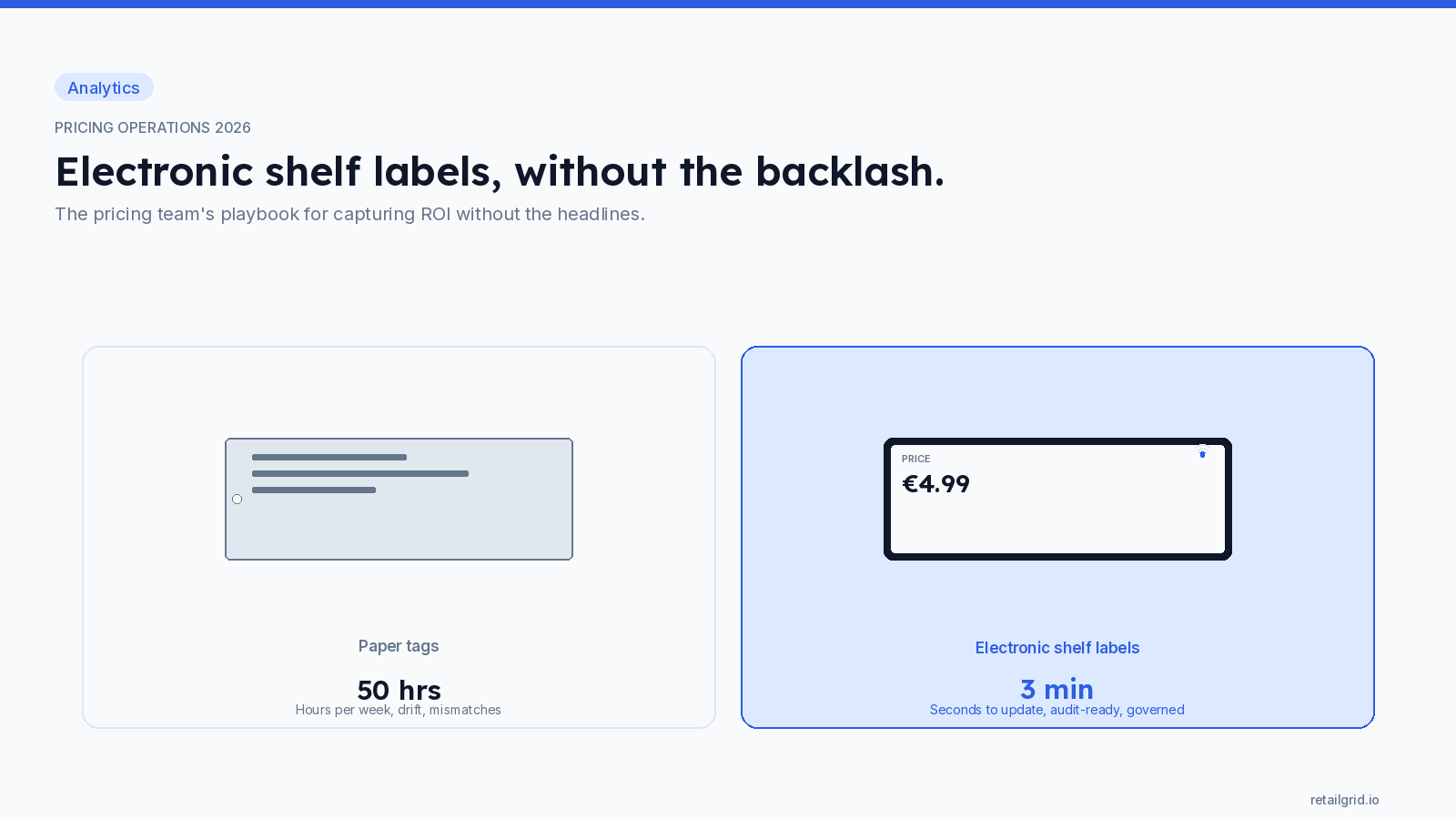
Most ESL pitches are aimed at store ops and IT. The labor savings are real — one regional grocer eliminated roughly 3,605 labor hours per month previously spent on manual tag changes, and an independent supermarket that used to spend 50 hours per week on 2,000 paper-tag updates now executes the same volume in three minutes. Pricing accuracy in mature deployments lands around 99.5%, which matters because NIST Handbook 130 fails any retail store with more than a 2% pricing error rate on inspection.
Those benefits show up on the operations P&L. They are not the reason a Head of Pricing should care.
The pricing-team reason to care is that ESLs collapse the lag between deciding a price and displaying a price from days to seconds. One major chain documented 30-second propagation time from ERP to shelf across thousands of stores. If your pricing engine outputs a new recommended price at 06:00, the shelf can reflect it before the doors open. If a competitor moves at 11:00, you can match by 11:01.
That changes the unit of work. With paper tags, pricing decisions get batched weekly because the cost of execution is the constraint. With ESLs, the constraint moves back where it belongs — to the quality of the pricing decision itself. Most pricing teams aren't ready for that shift, and the rollout fails in proportion to the gap.
The Four Use Cases That Justify the Spend (and the One That Gets You Sued)
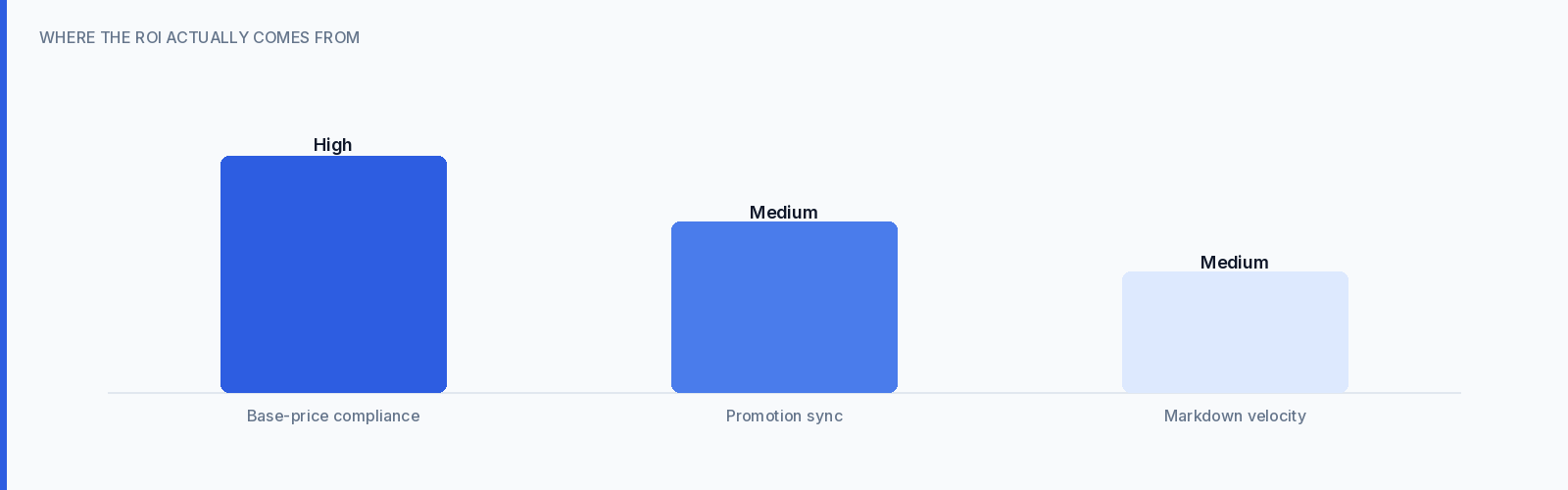
In every retailer ESL deployment we look at closely, ROI comes from the same four buckets. They are listed here in order of how often they show up in the early payback months — not in order of strategic importance.
1. Daily-base price compliance. This is the unglamorous one, and it pays back fastest. Your pricing system already publishes "this should be the shelf price." The shelf rarely matches. Tag rotation cycles, missed promotion endings, and forgotten regional overrides all create silent leakage — items selling above or below the system price. Forensic audits routinely find 3–6% of SKUs misaligned at any given time. ESLs collapse this gap to under 0.5% in stores with mature governance.
2. Promotion start/end synchronization. Every retail pricing manager has a personal horror story about a promotion that ended on Sunday and was still scanning at the discount on Tuesday. ESL systems with proper integration close this loop deterministically: when the system price changes at 23:59, the shelf changes at 23:59. One regional grocery chain reported a 61% reduction in pricing-discrepancy customer service calls within six months of full deployment.
3. End-of-life markdown velocity. For categories with perishability or seasonal short tails — fresh, fashion, garden, holiday — the cost of carrying the wrong price for a day is high. ESLs let you run multi-step markdown ladders (–15% Tuesday, –30% Thursday, –50% Saturday) without the tag-printing operation that historically slowed teams to one markdown per week.
4. Competitive matching on KVIs. For your two-to-three-hundred most price-sensitive items, ESLs let competitive intelligence translate into shelf moves on the same day, not next week. Critically, this is retailer-set pricing — every shopper sees the same price — and matches the same legal regime as paper tags. It just runs faster.
The fifth bucket is the one to avoid: individualized or personalized pricing, sometimes pitched as "dynamic surge pricing." Charging different shoppers different prices for the same item based on personal data is what every active piece of state and federal legislation is targeting. New Jersey's S3952 goes further — it would bar food retailers over 15,000 square feet from using any ESL system for four years after enactment, regardless of whether prices are personalized. The legal risk isn't that you'll be caught doing it. The legal risk is that the existence of the technology gets you grouped with retailers who are.
What "Surveillance Pricing" Actually Means — and What It Doesn't
The phrase has done a lot of work in the past nine months and most of it has been imprecise. Here is the operational distinction you need to defend with your legal team and your CMO:
Surveillance pricing, as drafted in the federal and most state bills, means using personal data about a specific shopper — loyalty profile, purchase history, device location, demographic inference — to charge that shopper a price different from what another shopper would see on the same shelf at the same moment.
That is the regulated activity. Three things that look superficially similar are not surveillance pricing under any of the bills currently in committee:
- Time-of-day pricing. Lower price on bakery items at 19:00 to clear product. Same price for every shopper.
- Store-level pricing. Different price in a downtown store than a suburban one. Same price for every shopper in that store.
- Competitive matching. Move on a KVI within minutes of a competitor's published change. Same price for every shopper.
The empirical record matters here. A study by researchers from UT Austin, UC San Diego, and Northwestern University examined over 180 million product-level data points from a grocery chain before and after ESL adoption and found no evidence of surge pricing or significant increases in rapid price changes after the rollout. Most ESL deployments don't increase price-change frequency dramatically — they just make the existing frequency more accurate.
The risk isn't that you're going to do surveillance pricing. The risk is that you'll look like you might be, and that's enough to make the seven-figure ESL investment a legal liability instead of an operational asset. The defense is built into the rollout, not bolted on after.
The Pre-Rollout Checklist Your IT Vendor Won't Give You
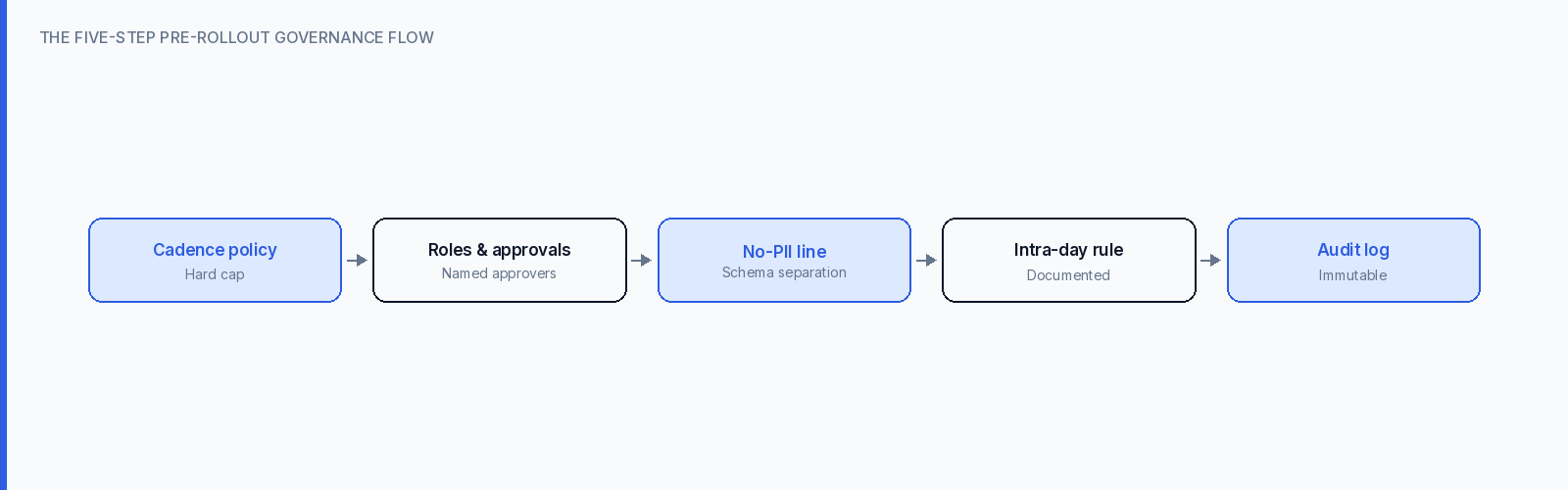
ESL hardware vendors are not going to walk you through this. They are paid to ship hardware. You and your CFO are the ones who will be sitting in front of state attorneys general or class-action plaintiffs if the deployment is sloppy. Five items, in order:
1. Decide your price-change cadence policy before you sign the PO. Most defensible: a formal limit — say, "no more than two base-price changes per SKU per week, excluding promotions." Document it. Build it as a hard constraint in the pricing engine, not a guideline. When a regulator asks "what stops you from changing prices every fifteen minutes?", you point at the constraint.
2. Lock down who can change prices and what kind of changes. Three roles, minimum: a pricing analyst who proposes changes, a category manager who approves base-price moves, and a system that auto-executes only pre-approved promotion calendars. Anyone who can edit a base price should be a named individual, not a service account. Every change should land in an immutable log.
3. Architect the system so individual-shopper data physically cannot enter the pricing decision. This is harder than it sounds because most loyalty platforms and CDPs already share the same data lake as pricing. Build a clear separation: pricing models can read aggregate demand signals (units sold per day per store per SKU) but cannot read or join to individual shopper IDs. Document the schema. Have legal sign off on it.
4. Decide on intra-day price changes and document the rule. Some retailers reserve the right to change prices intra-day on a small KVI list to match competitive moves. Some don't. Either is defensible. What is not defensible is having no documented rule and discovering, when subpoenaed, that 4,000 SKUs changed at irregular hours for unclear reasons.
5. Build the audit log every state law will eventually require. It needs four fields per change: who (named approver), what (SKU, store, old price, new price), when (timestamp), and why (reason code from a small fixed list — promotion start, promotion end, competitive match, base-price update, error correction). This will become table stakes in the next eighteen months. It also makes your own pricing decisions vastly more analyzable.
What ESLs Don't Fix
The honest section. Electronic shelf labels are an execution layer. They are not a pricing strategy. They make whatever pricing logic you already have faster and more visible, which is great if your logic is good and damaging if it isn't.
ESLs do not fix a pricing rule that was wrong. They make the wrong price wrong on every shelf, every minute. If your KVI list hasn't been refreshed in eighteen months, ESLs will let you defend obsolete prices very efficiently.
ESLs do not generate elasticity data on their own. Many retailers buy them imagining price-test capabilities will come for free. They won't. You still need a structured testing program — pre-period, test period, control stores, post-period analysis. ESLs make running the test cheaper. They don't run it for you.
ESLs do not align cross-channel pricing. If your e-commerce price comes from one system and your shelf price comes from another, ESLs will reveal the inconsistency, not heal it. Plan the integration before the rollout, not after.
And ESLs do not solve a misaligned KVI strategy. If you don't know which 200–300 items drive your customer's price perception, faster price changes will hurt margin without improving traffic. The KVI work has to come first.
The 12-Month Rollout Cadence That Survives the Legal Review
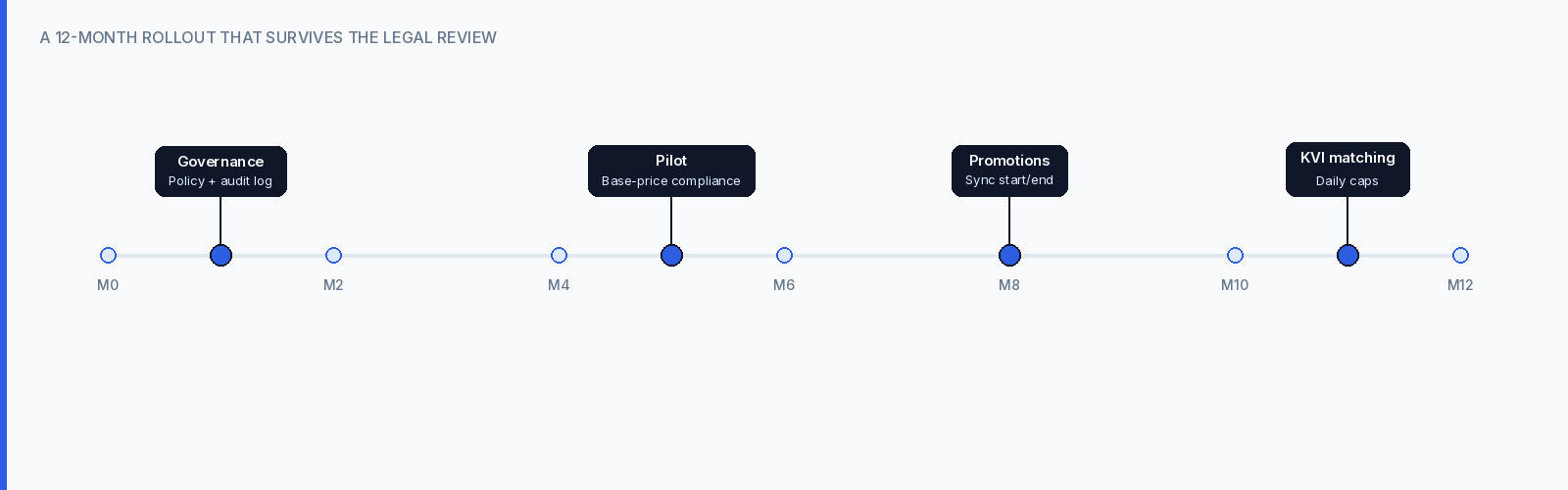
A staged rollout is harder to attack legally and easier to debug operationally. Treat it as four phases:
Months 0–2 — Governance. Write the price-change cadence policy. Define roles and approvals. Build the audit log schema. Get legal sign-off on the no-personal-data architecture. No hardware yet.
Months 2–6 — Pilot stores, base-price corrections only. Roll out to three to five stores. Use the labels exclusively to align shelf prices with system prices — the unglamorous compliance use case. Don't change frequency. Measure: customer service complaints, audit findings, employee time saved.
Months 6–9 — Layer in promotions. Synchronize promotion start and end across pilot stores. Measure leakage reduction. Now is when ROI becomes legible.
Months 9–12 — Enable rapid-response on KVIs. Roll out to remaining stores. Activate competitive matching on the documented KVI list, with a daily change cap and human approval on every match. Publish a public-facing "how we set prices" statement that affirms uniform pricing per store.
The retailers who will get hurt by the regulatory wave are the ones who skipped phase one and rolled out hardware before they had governance. The retailers who will thrive are the ones who treated the deployment as a pricing-discipline upgrade with hardware attached, not the other way around.
Where Retailgrid Fits
Retailgrid doesn't sell electronic shelf labels. We're the pricing brain that decides which prices the labels should display — with a rules-based pricing agent that produces an explainable, audit-ready trail behind every recommended price. ESL hardware solves the execution speed problem. The pricing decisions still have to be defensible.
If you're scoping an ESL rollout this year, the most useful thing we can offer is the audit-trail and governance layer that makes the technology pass legal review. The rules engine, the KVI-list maintenance, the promotion calendar with start/end synchronization, the immutable change log — that's the part of the stack that outlasts whichever ESL vendor you pick.
The label is the messenger. The pricing system is the message. Get the message right first.
Curious how Retailgrid structures the pricing brain behind an ESL rollout? Read the rules-based pricing reference in our docs or compare notes with our piece on where AI in retail pricing actually pays off.

